
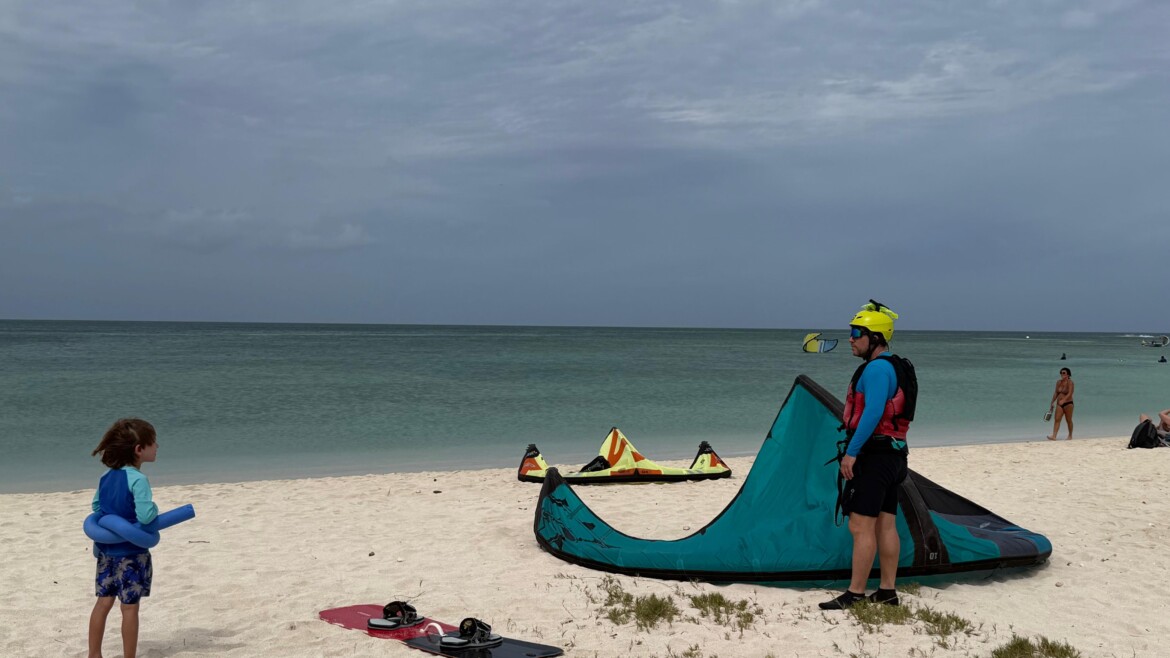
If you are searching for one of the best destinations to learn kitesurfing in the Caribbean, Aruba deserves a place at the top of your list.
Warm turquoise water, tropical temperatures and Aruba’s famous trade winds create an incredible environment for both first-time students and experienced riders.
At Aruba Kitesurfing School, our home is at Fisherman’s Huts in Noord, one of Aruba’s most famous watersports locations and only minutes from Palm Beach.
Whether you have never touched a kite before, want to improve your riding, or are an experienced kitesurfer looking for your next Caribbean adventure, this guide covers everything you need to know about kitesurfing in Aruba.
Why Is Aruba So Good for Kitesurfing?
There is one word every kitesurfer loves to hear in Aruba:
Wind.
Aruba is famous for its trade winds, which blow across the island during much of the year. Combined with warm Caribbean temperatures, this makes it possible to enjoy watersports without needing the heavy wetsuits associated with colder destinations.
For kitesurfers, Aruba offers another important advantage: very different riding environments on one relatively small island.
Beginners can develop their skills around Fisherman’s Huts, while more experienced riders looking for stronger wind, chop, waves and a different challenge can experience Boca Grandi.
That means Aruba isn’t only a destination where you can learn.
It is a destination where you can learn, progress and keep challenging yourself.
Where Is the Best Place to Learn Kitesurfing in Aruba?
For beginners, one of Aruba’s most established kitesurfing locations is Fisherman’s Huts, also known as Hadicurari Beach.
This is also the home of Aruba Kitesurfing School.
Located in Noord, just north of Aruba’s famous Palm Beach hotel area, Fisherman’s Huts has become synonymous with wind sports in Aruba.
For students, the location offers several important advantages.
There is shallow water close to shore, plenty of room for instruction and easy access from Aruba’s main tourism area.
Most importantly, you are learning in an environment where kitesurfing and wind sports are part of everyday life.
Can Beginners Learn to Kitesurf in Aruba?
Absolutely.
You do not need previous kitesurfing experience to start taking lessons.
A good beginner lesson does not begin by simply putting you on a board and hoping for the best.
Kitesurfing is learned step by step.
At Aruba Kitesurfing School, beginners gradually develop an understanding of the wind, equipment and kite before progressing toward riding independently.
Depending on your progress, lessons can include:
- Understanding the wind and basic wind theory
- Setting up and handling the equipment
- Kite control
- Safety systems
- Launching and landing
- Body dragging
- Power control
- Water starts
- Board control
- Riding in both directions
- Riding upwind
- Transitions
Everyone progresses at a different speed.
The objective isn’t to rush through the process. It is to develop the control, confidence and understanding needed to become an independent kitesurfer.
Learning Kitesurfing in Shallow Water
One of the biggest advantages of learning at Fisherman’s Huts is the shallow-water environment available close to shore.
When you’re learning a completely new sport, being able to stand up can make a significant difference.
Instead of spending unnecessary energy swimming back into position after every attempt, students can reset, listen to their instructor and continue practicing.
This allows more of the lesson to be focused on actually developing kite control and technique.
It can also make those first sessions feel much less intimidating.
Once the basics start clicking, everything changes.
The moment you successfully control the kite, get the board underneath you and experience your first real ride across Aruba’s turquoise water is something you won’t easily forget.
Fisherman’s Huts: Aruba’s Famous Kitesurfing Spot
Fisherman’s Huts has been part of Aruba’s windsurfing and kitesurfing culture for decades.
Its location near Palm Beach also makes it extremely convenient for visitors staying in Aruba’s main hotel area.
You can spend the morning learning to kitesurf and still be back near your hotel, restaurants and other attractions afterward.
But Fisherman’s Huts isn’t only for beginners.
As your skills improve, there is plenty to work on, including:
- Better board control
- Riding upwind
- Transitions
- Stronger kite control
- Jumping
- Freestyle progression
- Advanced riding techniques
This is one of the reasons we love teaching here.
The same location where you fly a kite for the first time can become the place where you later work on your first jumps.
What About Experienced Kitesurfers?
Already know how to kite?
Welcome to the windy side of Aruba.
Experienced riders can discover an entirely different kitesurfing experience at Boca Grandi, on Aruba’s southeastern coast.
Boca Grandi is exposed to the trade winds and offers open-ocean conditions, chop, swell and waves.
We like to describe it as a natural skatepark for kitesurfers.
The water itself becomes your playground.
Small waves and sections of swell can become natural kickers for jumps, while the open riding area gives experienced kiters room to work on freestyle, carving and more advanced maneuvers.
Boca Grandi: Aruba’s Kitesurfing Playground
Boca Grandi shows visitors a completely different side of Aruba.
Instead of hotels and calm resort beaches, you are surrounded by a much more rugged Caribbean landscape.
For capable riders, conditions can be fantastic.
You can work on:
- Big air
- Higher jumps
- Back rolls
- Front rolls
- Kiteloops
- Board-offs
- Freestyle
- Wave riding
- Advanced transitions
But there is an important distinction.
Boca Grandi is not where we recommend complete beginners start.
Open-ocean conditions, waves, stronger wind and deeper water demand better kite control and greater independence.
Learn the fundamentals first.
Master your kite.
Build your confidence.
Then the playground gets much bigger.
When Is the Best Time to Kitesurf in Aruba?
Aruba benefits from trade winds through much of the year, which is one reason the island has developed such a strong wind-sports culture.
Generally, the most reliable wind period is during the long trade-wind season, while conditions can become less consistent during parts of the fall.
But wind is weather, and weather is never guaranteed.
The important advantage Aruba offers is that kitesurfing isn’t limited to a tiny seasonal window.
For many visitors, that makes planning a kitesurfing vacation much easier.
And because Aruba stays warm throughout the year, your kite vacation still feels like a Caribbean vacation.
Do I Need to Bring My Own Kitesurfing Equipment?
If you’re coming to Aruba specifically for a kite vacation and already own equipment, bringing your own gear can make sense.
If you’re learning, however, you don’t need to buy an entire setup before discovering whether you love the sport.
Lessons at Aruba Kitesurfing School can provide the equipment needed for your instruction.
Your instructor can also select equipment based on your size, experience and the day’s conditions.
That is particularly important in kitesurfing because choosing the right kite isn’t simply about using the biggest or smallest one available.
Wind strength, rider weight, skill level and conditions all matter.
How Many Kitesurfing Lessons Will I Need?
This is one of the most common questions beginners ask us.
And there isn’t one number that applies to everybody.
Some students understand kite control very quickly. Others need more time before everything starts to feel natural.
Your athletic background, comfort in the water, wind conditions and how frequently you practice can all affect your progression.
Instead of asking:
“How quickly can I stand on the board?”
A better goal is:
“How can I become a safe and confident kitesurfer?”
Standing on the board is exciting.
Understanding what you’re doing is what eventually allows you to kite independently.
Is Kitesurfing Difficult?
Kitesurfing has a learning curve, but professional instruction makes that learning process much more structured.
Many beginners initially assume the sport requires enormous upper-body strength.
Technique and kite control are far more important.
Once you learn how to position and control the kite correctly, you begin using the wind instead of fighting against it.
That moment when everything starts working together—the wind, kite, board and rider—is exactly why so many people become addicted to the sport.
Kitesurfing Lessons With Radio Communication
Communication is extremely important when learning on the water.
At Aruba Kitesurfing School, we use BBTalk radio communication during applicable lessons so instructors can continue coaching students while they are riding.
Instead of having to return all the way to the instructor after every attempt, you can receive guidance while practicing.
Small corrections at the right moment can make a huge difference.
Move the kite.
Change your body position.
Adjust your board.
Look in the direction you want to travel.
These real-time instructions help turn each attempt into a learning opportunity.
Can Families Learn Kitesurfing in Aruba?
Kitesurfing can become much more than something you do alone.
We’ve welcomed parents, children, couples and families who want to experience the sport together.
For families visiting Aruba, learning a new watersport can become one of those vacation experiences everyone remembers long after returning home.
While suitability depends on factors including age, physical ability, swimming confidence and conditions, our team can help determine the appropriate lesson setup for each student.
More Than Kitesurfing
Aruba’s wind opens the door to several ways of enjoying the water.
In addition to traditional kitesurfing, Aruba Kitesurfing School also works with riders interested in progressing into other wind-powered disciplines such as wing foiling.
For experienced kitesurfers, progressing into jumping and advanced riding can turn a normal Aruba vacation into a dedicated training trip.
And for complete beginners?
It all starts with learning how to control that first kite.
What Should You Bring to a Kitesurfing Lesson?
Keep it simple.
Bring:
- Swimwear
- Reef-safe sunscreen
- Water
- Sunglasses before and after your session
- A towel
- A positive attitude and willingness to learn
Most importantly, arrive ready to have fun.
Kitesurfing is a technical sport, and mistakes are part of learning.
Every body drag, failed water start and short first ride teaches you something.
Then suddenly one attempt works.
You stand up.
The kite powers.
The board starts moving.
And you’re riding.
That’s usually the moment people understand why we love this sport so much.
Why Choose Aruba Kitesurfing School?
We don’t simply want to put someone on a board for a photograph.
We want our students to understand kitesurfing.
That means learning how the kite behaves, how the wind works, how to react when something doesn’t go according to plan and how to become increasingly independent on the water.
Our location at Fisherman’s Huts in Noord, Aruba puts you directly into one of the island’s most established wind-sports environments.
From your first lesson to more advanced coaching, the goal remains the same:
Learn. Progress. Ride with confidence.
Kitesurfing in Aruba FAQ
Is Aruba good for kitesurfing?
Yes. Aruba’s trade winds, warm temperatures and established kitesurfing locations make the island an excellent destination for kitesurfing. Beginners can learn at Fisherman’s Huts, while experienced riders can explore more challenging conditions such as Boca Grandi.
Where can I learn kitesurfing in Aruba?
Aruba Kitesurfing School is located at Fisherman’s Huts in Noord, close to Palm Beach and Aruba’s high-rise hotel area.
What is the best kitesurfing beach in Aruba for beginners?
Fisherman’s Huts is one of Aruba’s main locations for learning because of its established watersports community and shallow-water training area.
Where do advanced kitesurfers ride in Aruba?
Boca Grandi is popular with experienced riders looking for open-ocean conditions, stronger wind, chop, waves, freestyle and jumping opportunities.
Can I take kitesurfing lessons without experience?
Yes. Complete beginners can start with the fundamentals, including wind theory, safety, kite control and body dragging before progressing toward water starts and riding.
Do I need my own kite?
No. Beginners taking lessons can use the equipment provided for their instruction.
Is the water warm in Aruba?
Yes. Aruba enjoys warm tropical conditions throughout the year, making it a comfortable destination for watersports.
Is kitesurfing the same as kiteboarding?
The terms kitesurfing and kiteboarding are commonly used interchangeably. Travelers searching for either kitesurfing Aruba or kiteboarding Aruba are generally looking for the same sport.
Ready to Go Kitesurfing in Aruba?
Your Aruba vacation doesn’t have to be spent watching the Caribbean from a beach chair.
Ride it.
Feel the trade winds.
Learn to control the kite.
Make your first water start.
Ride your first meters.
And discover why people from around the world fall in love with kitesurfing.
Whether you’re a complete beginner or an experienced rider looking to progress, Aruba Kitesurfing School is ready to welcome you at Fisherman’s Huts.
Learn to kite. Ride Aruba.
Contact Aruba Kitesurfing School and start your kitesurfing adventure in Aruba.
Add Your Comment